 Primary school
Primary school
I · Class 1 (Year 3)

'We are going to learn to read'
'We are going to learn to read.' With high expectations the children begin class one.
Now it counts; they are really big and belong to that mysterious world of the big school. Gathered at the school door, one shy, another boisterous and overconfident, they stand ready to step over the threshold.
The children want to learn, and most children above all want to be able to do a lot. It is often a real disappointment that after a week, let alone after the first day, you still cannot read a book, write a letter or do sums. Fortunately that does come within reach quite quickly.
The children happily want to do everything the teacher says, because the teacher can teach us to write, read and count. What the teacher says is true.
Now they are big, that is how they feel themselves, and we build on that. We put in place the habits that matter for learning in the primary years; this is how we do things here at school.
Learning the school habits does not always go smoothly. Many children have a dip halfway through the year, when they like to visit the kindergarten class again.
In the first class we work on structure and clarity, so the children know how things go at school. Structure also involves a degree of form. For some children it is still difficult to fit into that form, others could hardly wait to step into it. Sitting still at your place, raising a finger to speak, listening to someone else, walking through the corridors, looking after each other, putting your chair on the table at the end of the school day, and so on.
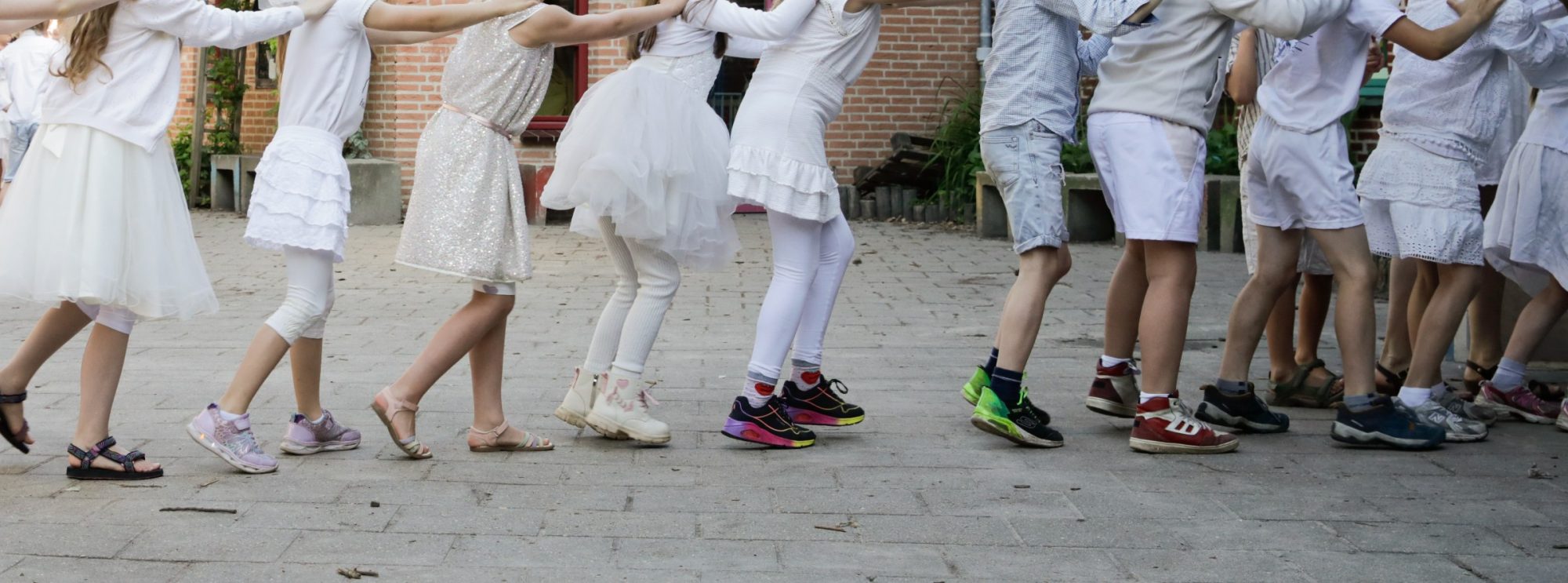
And then the learning itself. Forms are walked, drawn large in the air or somewhat smaller on paper. There is jumping back and forth on the number line, stamping and clapping to recognise the times tables. Hopping, jumping, skipping rope and circle games are part of the curriculum. First do, then experience, and finally understand.
In the first class the transition is made from the more implicit learning of the kindergarten class to the explicit learning of the primary school.
The storytelling material of the first year consists of folk fairy tales such as those collected by the Brothers Grimm. During the story it grows quiet in the classroom. Dreamily the children live along with the stories in which good always wins.
II · Class 2 (Year 4)

Dialogue
The second-class child has definitively left the kindergarten world behind, but fantasy and playfulness are still very much present. The individuality of the child comes increasingly to the fore. Among other things, this has to do with the emerging temperaments. The second-class child freely expresses their energy; talks, makes a lot of noise, is ready for a scuffle, in short, hides nothing. A second-class child wears their heart on their sleeve and their view of the world has sharpened. They point out qualities in each other that they do, or do not, appreciate. They seek out boundaries and test them. This sometimes causes clashes and disagreement between the children. Open, spontaneous and empathetic when situations are talked through afterwards.
The theme of the second class, woven through various lessons, can be characterised by the word 'dialogue'. So you find in the painting lessons exercises with complementary colours, in form-drawing lessons mirror exercises, in music lessons call-and-response songs, and in the storytelling material the conversations between animals and the saints in dialogue with themselves or the Divine.
The storytelling material of the second class is that of fables and legends of saints. In the fables, animals with human character traits are shrewdly portrayed. Human qualities are attributed to and exaggerated in the animals. Against this stand the legends of saints, in which the person, often after an inner struggle, gives their strength to the world. They come to insight; both the fable and the legend express a natural morality, in which a judgement of good and evil remains unspoken.
In the second class the children learn to work for longer stretches than before, with the necessary concentration. Thinking and memory become more independent and stronger. Self-reliance and the ability to listen increase, and they are eager to learn. Everything offered to them, they eagerly take in.
III · Class 3 (Year 5)

'Becoming at home in the world around you'
'Becoming at home in the world around you' is the central theme of the third class.
How do we live and work? And how do I relate to other people? Many lessons pay attention to craft skills. How does a farmer or a miller work? How do you make bread from grain? How can I improve my technique in writing or painting?
It is often said that children in the third class close their 'golden childhood'. The children step into culture, they become a child of their time. This is also visible outwardly. Suddenly certain clothes are discarded or there is a clear preference for a particular hairstyle.
Third-class children are curious and very eager to learn. They constantly ask how things work. Knowing something, understanding a subject, or being good at something, becomes the yardstick by which adults too are increasingly judged. It is a forerunner of the development that will continue the following year. In the third class children still vary strongly in their relationship to authority. One moment the teacher is looked at critically, the next moment what the teacher says is still law.
For the first time, friendships begin to form that last much longer and cut emotionally deep.
In the storytelling material the children hear the stories from the Old Testament. In them people leave paradise and again and again leaders arise who lead the people forward. Eventually they reach the promised land. It is an image for the development the third-class children themselves also go through; that of ever-advancing individualisation. The 'I' and thinking about the world.
In the arithmetic periods, attention is paid to working with money and all facets of monetary exchange. Basic skills are automated; in reading, arithmetic and spelling the foundation has been laid.
In language periods or lessons, children learn, through writing and reading themselves, to recognise different types of text. The teacher also pays attention to the craft aspects of care, such as learning to use correct punctuation. The children can look at language with increasing distance and talk about language with each other. In handwork, children often knit their own hat, as a symbol of being able to be with yourself, to close yourself off.
In local-studies lessons the children learn, alongside the crafts, more specifically what running a farm involves. A house-building period is also planned. Children learn all about houses and the various trades involved, but often also design their own house or hut. When a house is built, it is finished off with a roof, so that suddenly a difference arises between inside and outside. In the transition from the third to the fourth class, children also take a big step in experiencing their inner world and the outer world.
IV · Class 4 (Year 6)

Looking at the world with distance
A fourth-class child looks with more distance at themselves, their classmates and the world. The realisation that everyone is different and has their own peculiarities dawns in full force on the children.
This 'awakening' creates uncertainty and stirs up emotions. Children are suddenly overwhelmed by great sadness or become afraid of the dark again. 'Tough' or cheeky behaviour suddenly appears. Insecurities express themselves.
This phase also offers space, a new world opens up. In classes one to three the day started with 'The loving light of the sun brightens my day...'. From the fourth class the children begin the day with 'I look around in the world, in which the sun sends its light...'. The children position themselves actively in the world.
In the curriculum we see that the fourth-class child not only looks at themselves with more distance, but also learns to place themselves in time and space. In geography the children learn to draw maps, they learn to view the world from above. In arithmetic, fractions are introduced, where children get to know a whole new world of numbers that lie between the 'familiar' 0 and 1, and that the number 1 turns out to have the same value as 2/2 or 45/45. They learn that in language you can express that events can take place in past, present and future.
The storytelling material of this year, the Edda, contains courageous tales of a struggle between the gods and natural beings such as giants and dwarves. Doom threatens the gods. These stories are the imaginative expression of what the children in class four experience inwardly: what exists is disappearing, something new is coming. The downfall is inevitable and does not happen without a struggle, but after the downfall comes the resurrection of the new human being. That is the perspective the Edda offers the children: 'Your old world lies behind you, you cannot go back there, but a new world lies ahead of you!' Courageous stories for children who could use some courage in this phase of their lives.
V · Class 5 (Year 7)

Bigger connections
In the fifth class the children often form a close-knit group. It becomes less self-evident to involve adults in their lives. The children like to talk to each other about what occupies them. They are empathetic and take an increasingly strong stand against injustice. They regularly overstep the mark in doing so, because making nuanced judgements is still complicated. It is also the class where bullying and teasing behaviour can suddenly get out of hand. Class discussions in which the children learn to listen to each other and speak up towards each other are of great importance. Thinking is examined, viewpoints are experimented with, they take a stand and compare different perspectives.
In the curriculum, ever bigger connections are made with people here and now. In the geography period, for example, the children trace the origin of a seemingly everyday product they have at home. They find out what journey that product went through before it arrived at their home. In researching this journey they discover that a great many people have been involved and that those people are somehow connected to, or even dependent on, each other. With wonder and respect they can now look at these products.
In the history period an overview is given of ancient cultures; from Babylon, India, Persia, Egypt through to that of the Greeks.
In botany the children get an overview of all kinds and families, from mushrooms, to mosses and ferns, to more complex plant forms.
The storytelling material this year is the Greek myths and legends, in which the gods wrestle with human traits such as jealousy and vengefulness, and in which the inner world of Greek heroes is experienced along with them. The mythological stories shift increasingly towards historical events.
VI · Class 6 (Year 8)

Truth, justice and the approaching secondary school
In the sixth class, the self-evidence of the world is lost. Good does not always win any more. The approaching adolescence announces itself. Being fair, being consistent and speaking the truth rank high on the agenda in class discussions. It is also the class in which the children suddenly want to work seriously. The children ask for clear rules and sanctions, when there is a departure from agreements. They want insight into the actions of the teachers. When they know why they must learn things, they can show great commitment. Teachers must therefore change their attitude towards the children and may increasingly take on the role of guide and process-watcher.
Truth, justice and precision are things through which the sixth-class child wants to experience the beauty of things. Here ethics can sometimes come under strain. These conflicts of conscience are eagerly investigated. In the storytelling material these conflicts also become visible. The storytelling material is at the same time history material. Numerous stories from Roman history and the early Middle Ages invite children to make inner and ethical conflicts something they can experience. The sixth-class child takes sides here and will defend their position to the bitter end.
In the period on the Middle Ages, the history of Christianity is discussed alongside that of Islam. The biographies of Muhammad and of Charlemagne are studied, for example. Encyclopaedias, information from the internet, informative texts from textbooks are read and compared. What is the truth? How do adults think about that? The children begin to put themselves in different viewpoints alongside each other – in debates they learn to voice opinions that are not their own.
For the first time the children get physics – phenomena from the fields of light, heat, sound, magnetism and static electricity are examined, and laws are discovered and formulated within them: I had, I did, I saw and I concluded. In the geometry period children construct their drawings with great precision. They learn that beauty can arise from this and that every minimal deviation of a line or circle disturbs the geometry. In this way children train, among other things, their exact observation. When their drawings, finally finished with patience and carefully chosen colours, hang in the school, the sixth-class children rise even further in esteem throughout the school – their work is admired and discussed at length by children from the lower classes. The sixth-class children have truly become the class the other children look up to; they are the eldest of the school.
Block exercise book
In each block, children work in their own exercise book: a self-made workbook with drawings and texts about that period's subject matter.
Subject lessons
Alongside block teaching there are fixed subject lessons: language, arithmetic, eurythmy, music, handwork and foreign languages, spread through the week.
Seasonal festivals as the rhythm of the year
The seasonal festivals structure the school year and connect the classes with each other and with the rhythm of the seasons.
Come and feel the atmosphere.
Plan a personal introduction with our team, or visit one of the information mornings during the year.